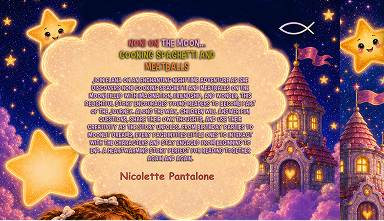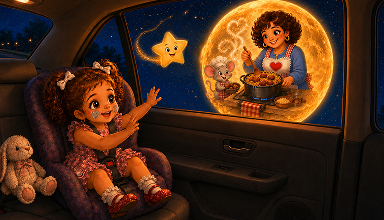
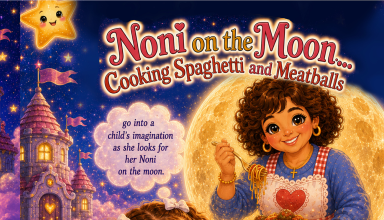
As the author of Noni On the Moon: Cooking Spaghetti & Meatballs, I’ve spent a lot of time reflecting on the incredible power of a child’s imagination. In fact, the entire idea for this book came from a simple moment with my daughter during a nighttime car ride. She was tired, cranky, and completely uninterested in anything her father and I were saying. Then I glanced out the window, saw a beautiful full moon, and casually said, “Look, Noni is on the moon cooking spaghetti and meatballs.”
Almost immediately, everything changed.
The tears stopped. The questions started. Suddenly, she wanted to know what Noni was cooking, who was helping her, and whether she lived on the moon all the time. Before we even reached home, an entire world had been created. There was a moon kitchen, moon friends, moon adventures, and countless stories waiting to be told. Looking back, I realize that moment perfectly captures what pretend play does for children every day. It takes something ordinary and transforms it into something extraordinary. More importantly, it helps children develop creativity, confidence, and problem-solving skills without them ever realizing they’re learning.
When a Cardboard Box Becomes a Spaceship
One thing I’ve learned over the years is that children don’t need much to spark their imagination. Adults often spend a lot of money searching for the perfect toy, while children happily turn the shipping box into the real entertainment. I can’t tell you how many times I’ve watched children ignore what’s inside the box and become completely fascinated with the box itself. A cardboard box can become a spaceship heading to Mars, a pirate ship sailing through dangerous waters, or a secret headquarters where important missions are planned. A blanket draped over two chairs suddenly becomes a castle. A wooden spoon becomes a magic wand. A stuffed animal becomes a patient, a student, or the owner of a very successful bakery.
I remember one afternoon when my daughters turned our living room into a zoo. Every stuffed animal had a name, a personality, and apparently a very specific diet. One lion would only eat pretend pancakes, while a giraffe insisted on spaghetti. For nearly two hours, they solved animal emergencies, planned feeding schedules, and gave guided tours to invisible visitors. To anyone passing by, it probably looked like complete chaos. To them, it was an important day at the zoo. What fascinated me wasn’t the game itself. It was watching them naturally create stories, solve problems, and adapt whenever something unexpected happened.
Creativity Grows When Children Lead the Story
One of the greatest gifts of pretend play is that children become the authors of their own adventures. Nobody tells them what happens next. They decide. They create the characters, invent the challenges, and figure out how the story ends. As a writer, I understand how difficult it can sometimes be to come up with ideas. Children don’t seem to have that problem. Give them five minutes, and they’ll create an entire universe complete with heroes, villains, magical creatures, and at least one character who insists on eating cookies for breakfast.
What I love most is watching how quickly their stories evolve. A tea party can suddenly become a royal meeting. A backyard treasure hunt can turn into a rescue mission. A trip to the moon can become a spaghetti dinner with a mouse and a star. Children aren’t worried about whether their ideas make sense. They’re simply exploring possibilities. That freedom allows creativity to flourish in a way that adults often forget is possible.
Problem-Solving Hides Inside Every Adventure
The funny thing about pretend play is that children spend most of their time solving problems without realizing it. Imagine a child pretending to run a restaurant. Suddenly, a customer wants pizza, but the kitchen only serves spaghetti. Another customer arrives, and there aren’t enough seats. Then someone accidentally knocks over an imaginary bowl of soup.
Now what?
The child immediately starts finding solutions. Maybe they will invent a new menu item. Maybe they can build more chairs using couch cushions. Maybe the spilled soup becomes part of a hilarious kitchen disaster that everyone laughs about.
Children do this naturally because they’re invested in the story they’ve created. They want the adventure to continue, so they figure things out as they go. I’ve often thought that adults could learn something from this approach. Children don’t spend much time worrying about obstacles. They simply ask, “What can we do next?” Then they try something. That’s a pretty valuable life skill!
Why Mistakes Are Part of the Fun
One of my favorite things about pretend play is that mistakes rarely feel like failures. In fact, they often make the game more interesting.
If a child’s blanket castle falls down, it doesn’t ruin the adventure. Suddenly, there’s been an earthquake, and everyone must rebuild the kingdom. If the pirate ship sinks, perhaps they’ve discovered a hidden underwater city. If the moon chef accidentally drops a meatball, maybe a friendly moon mouse saves the day.
Children have an amazing ability to turn setbacks into opportunities. Their imaginations help them see possibilities where adults often see problems. I think that’s one reason pretend play builds confidence. Children learn that mistakes don’t have to end the story. Sometimes they become the best part of it.
The Connection Between Pretend Play and Noni On the Moon
When I look back at how Noni On the Moon: Cooking Spaghetti & Meatballs began, I realize it started exactly the same way most pretend play begins—with a simple “what if.”
What if Noni lived on the moon?
What if she was cooking spaghetti and meatballs?
What if she had friends who came over for dinner?
Those questions opened the door to an entire world filled with imagination, friendship, laughter, and adventure. The book itself grew from the same creative thinking children use every day during pretend play.
This is one of the reasons I think children connect so easily with stories like this. They already understand how imagination works. They know that a moon can become a kitchen and that a mouse can become a chef’s assistant. To them, those possibilities feel completely natural.
The Adventure Doesn’t End When Playtime Is Over
As adults, it’s easy to see pretend play as something children do simply to pass the time. But after years of watching children create their own worlds, I’ve come to believe it’s one of the most important things they do.
Through pretend play, children learn to think creatively, adapt to challenges, solve problems, communicate ideas, and build confidence. They practice skills that will help them throughout their lives, all while having fun and making memories.
Perhaps that’s why I love imagination so much. It reminds us that the world is full of possibilities. A cardboard box can become a spaceship. A living room can become a zoo. And a bright moon hanging in the night sky can become a place where a grandmother cooks spaghetti and meatballs for her friends.
The next time you see a child deep in a make-believe adventure, take a moment to appreciate what’s really happening. They aren’t just playing. They’re creating, learning, and discovering what might be possible. If you’d like to join a moonlit adventure filled with imagination, friendship, and plenty of spaghetti and meatballs, I invite you to read Noni On the Moon: Cooking Spaghetti & Meatballs. You never know where a little imagination might take you.